Rebekah Snyder
Driving through the arid desert and canyon lands, the Verdin is a reminder that all places are unique and beautiful in their own way. These striking birds are desert specialists and add a flash of brightness and color to their arid world.
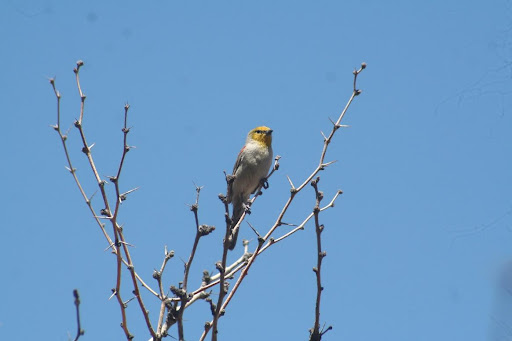
Verdins are small songbirds (about 4.5 inches in length) and are gray overall and lighter-gray below. Their most distinguishing field characteristics is their striking yellow-golden head and throat. Upon closer inspection, you will also see a rusty-red shoulder patch on the upper part of the bird’s wing. Their dark, sharp, and slender bill provides them ample ability to forage for insects, spiders, and occasionally fruit and nectar from hummingbird feeders.
Upon seeing a Verdin for the first time, you might say this bird looks almost like a bright chickadee – and if so, you aren’t terribly far off in that guesstimate. The Verdin is a member of the Penduline tits, a group of birds classified in the family Remizidae. Birds of this family are related to the true tits (tits, titmice, and chickadees) but Verdins are the only species of this group found in the New World. They are restricted to the southwest deserts of the United States and Mexico.
Verdins are desert specialists because of their preference for shrubby desert habitat. A “specialist species” is what scientists like to call animals that either live in a particular place or have a particular diet (or both). More importantly though, specialist species have little flexibility beyond those parameters. Because of this, they are considered restricted. Verdins are considered specialist species because they are restricted to their range and only live and reside in desert habitat. From a conservation perspective, that makes these desert habitats very important!
Although small, they are strong and mighty. As yearlong desert residents, they have adapted to live in some of the harshest conditions in Texas. They withstand the intense hot summers and frigid cold winters that the desert endures, and as nonmigratory songbirds, they reside in these places all year round, never growing weary.
The first Verdin I saw was in Nevada, outside Las Vegas. It was also the first time I had ever visited a desert before, and I was mesmerized by its dry and arid beauty, and the colors of the Verdin. The second time I saw a Verdin was in southwest Texas, not too far north from the border of Mexico. I was wandering along a rocky trail that led farther into a canyon when I heard the Verdin’s 2-3 notes song. I grabbed my binoculars and began to look around. I’d hear him again, and slowly, I’d follow the song I heard till I found a tiny songbird fluttering amongst a shrub.
He was bright, he was handsome, and he was loud. Perched amongst the thorns, the Verdin sang his heart out without fear of being watched. A song that echoed throughout the land. A song only intended for one. His golden head beamed in contrast to the landscape, a memory that pictures just cannot do justice.
In a way, Verdins are like members of the hospitality department of the southwest – ready and willing to greet you to the desert as soon as you arrive. “Thank you for visiting, we hope you come again.”

