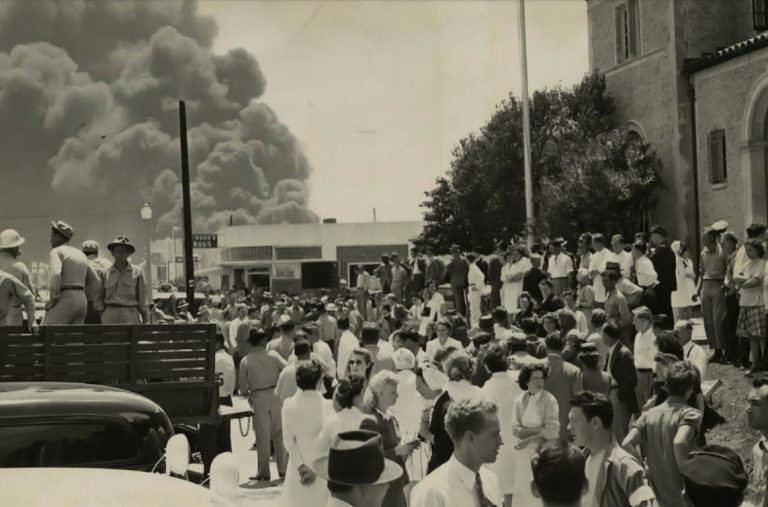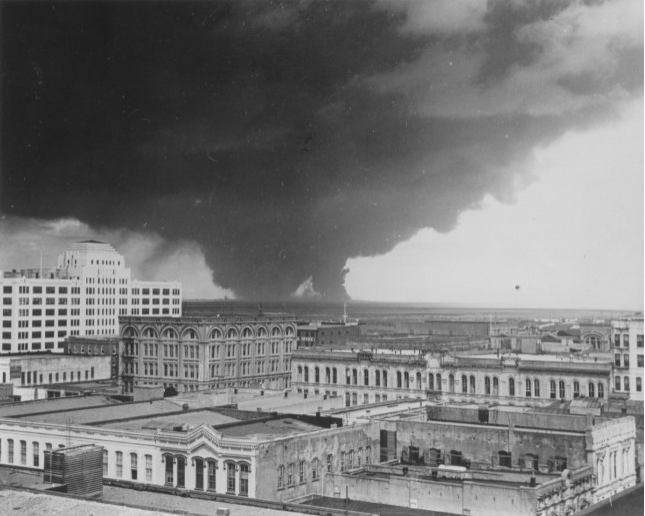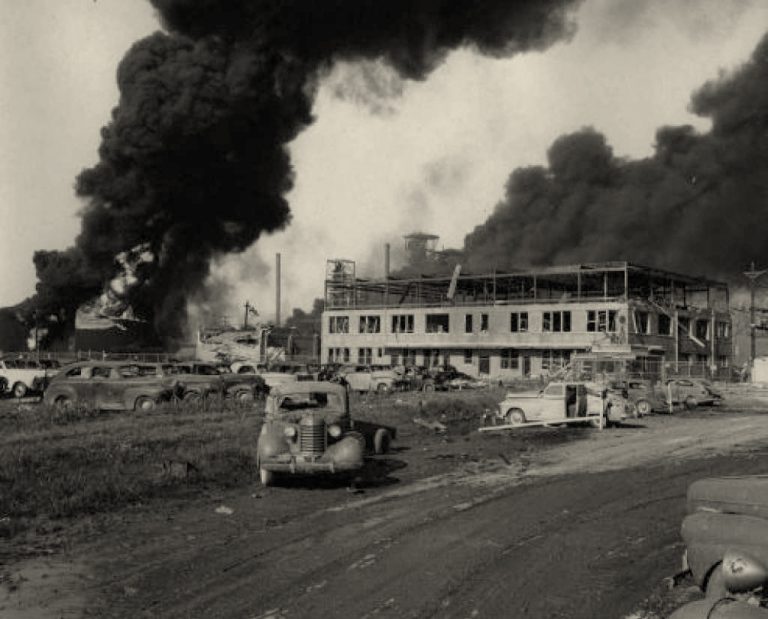
Editor’s Note: Sunday, April 16, marks the 76th anniversary of the moment that rocked Texas City when the French freighter Grandcamp, filled with ammonium nitrate fertilizer, exploded in the Port of Texas City, a blast so devastating it was heard more than 150 miles away. Later that evening, a second explosion on the freighter High Flier added to the destruction which led to the loss of 568 lives and injuries to thousands of others.
To this day, it remains the largest loss of life in an industrial accident in the United States along with being the largest non-nuclear explosion in American history.
I attend First Christian Church with Betty Calhoun, who gave me the opportunity to share her harrowing story of survival in the face of fear that fateful morning. This story originally ran in the April 14, 2019 edition of The Post Newspaper, yet I feel Betty’s story should again be shared to display the courage of what a then 8-year-old girl faced when the world around her fell apart.
THE MORNING OF APRIL 16, 1947 was like any other in the life of a then 8-year-old Betty Calhoun. As she went to school on the chilly Wednesday morning in Texas City, events at the Port of Texas City would place her front and center of the deadliest industrial accident in American history.
Calhoun was in class at 9:12am when the French ship Grandcamp’s ammonium nitrate exploded, causing a 15-foot wave of death and destruction. Now 80, Calhoun shared her experience of that fateful day with The Post Newspaper Associate Editor Brandon C. Williams:
“It was really chilly that morning, and the flames were orange, and everyone was looking at the flames and smoke. Even the kids (in class) were. They had those old manila shades that rolled up and down, and those were at my back. The chairs were facing the opposite direction. The windows and the manila shades all blew over the place.
“When the stairs collapsed, I was upstairs, and the school was all blown to pieces. The kids tried to push me off where there were no more stairs. It was just a cloud of dust. It was granite stairs and it had all crumbled, and it was just like smoke.”
With all hell breaking loose, Calhoun then realized her best chance of survival would come from facing one of her biggest fears.
“They were pushing in panic – and we were little kids — and I squatted down and behind the legs and I went down the hall. I went down a metal…it was like a slide from upstairs and I was scared of heights, but I went down that metal slide and I went under the oak trees and down the sidewalk to 6th Street and I crossed over to where the hat shop and Penney’s and all of that was.
“My parents told me that if anything happens and we can’t pick you up, you go to the police station. I walked through all that broken glass. My feet were so full of broken glass that (later) I kept begging the nuns to quit digging because my feet were so full of glass. I was so scared that I didn’t realize I was walking through all that glass. I made my way through all of that and got to city hall, and I went upstairs.”
It was there that Calhoun – who would eventually become Miss Texas City – remained despite the chaos and tragedy that surrounded the then-second grader.
“I went into the police station and I was the only one there. Because my feet were bleeding and hurting, I sat up on the dais and looked out the windows that weren’t there anymore because the glass was all gone. I sat there, and I sat there and nobody was there, but that’s what I did because that’s what I was told to do.
“There was a little girl that had been scalped. She had a puppy in her arms and she was saying to anybody, ‘take my dog.’ She had no top on her head. You couldn’t do nothing because her face was dried up with blood and the top of her head was gone. I had never seen anything like that before.
So, I took the little dog and kept it until that night.”
Calhoun would remain there for several hours until her ordeal of being alone came to an end after dark.
“My mother found me. My daddy was in the explosion and was underwater and under the building, but he survived. My mother was a nurse at that time and was on 6th Street and then went to the hospital looking for both of us. They told her we weren’t there, but she had to stay because they needed her. They tried to make her stay, but she told them, ‘I have to find my husband and my daughter,’ so she left.”
With death and destruction throughout Texas City, the Calhouns looked for a place to recoup that night. However, it would not take long for their plans to remain in Texas City to become altered.
“That night, they told us the second ship (the High Flier) was about to blow up and we needed to leave town. My mother and my dad and I went to the Catholic Church in Dickinson on FM517 and the corner.”
It was there, that finally, she received treatment for her glass-riddled feet.
“Most of my feet had puncture wounds. The glass was so embedded that it turned white. I had ballerina slippers on that day. I didn’t know if I had them on still. I just remember looking at my feet and there was blood on the floor. I may not have had my shoes on at that time, I don’t know.”
Like many in the area, the Calhouns were able to eventually begin life anew. Betty Calhoun never left the area, as she lived in Texas City for years before finding her way to her current home in Santa Fe. Hurricane Harvey caused considerable damage to her home, including the loss of manuscripts of her father’s experience of that fateful day.