By Ashley Van Wieren
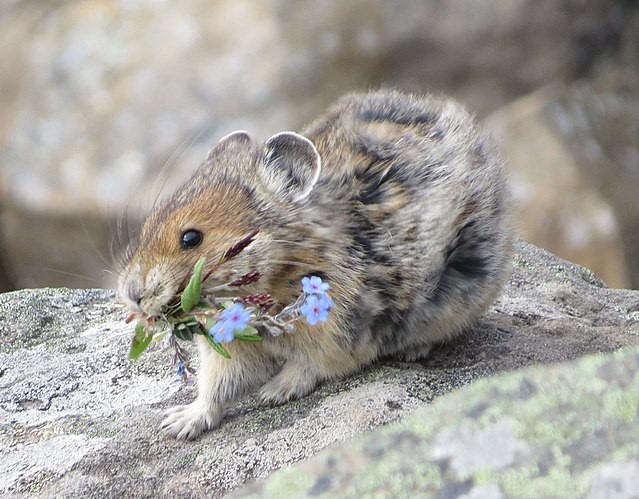
Spring is approaching and wildflowers are in bloom! In the mountains of the Western US, the American Pika is ready to feast on these flowers! The pika is a tiny creature, roughly the length of a standard #2 pencil. Their small bodies, short legs, and short round ears suggest a rodent-like appearance; however, pikas belong to the order Lagomorpha, making them relatives of rabbits and hares. The American pika, Ochotona princeps, is tailless with sharp claws that add agility when traversing rocky mountain terrain.
The pika uses its two sets of incisors, characteristic of lagomorphs, to cut off flowers, grasses, thistles, and weeds. This tiny florist has a taste for flowers like no other, as it gathers flowers during summer to bring back to its den. This practice of stashing meals for later is called haying. They create a nest under rocks that is lined with edible plant materials to cozy up in and snack on throughout the winter. These collections of grasses and flowers can grow to be large enough to have more than enough food for the entire year! Toxic plants act as preservatives and slowly detoxify throughout the season, eventually becoming edible.
When winter rolls in with bellowing winds, remaining vegetation dwindles, leaving minimal food such as lichen and bark to eat. The American pika, which does not hibernate in the winter, must find another way to keep itself warm and fed to survive these harsh conditions.
The cinnamon-brown coat of summer is transformed into a thicker gray coat to pair with furry feet. Lucky for the pika, it has been preparing for the chilled winter seasons since summer. The pika can now reap the rewards of its summer labors and cozy up in its edible nest, a warm and tasty pile of foraged summer treats. Uneaten food in spring leftovers eventually decays, replenishing the ground with nutrients.
American pikas are colonial which allows them to warn each other of predators. However, they tend to live separated lives within the colony, as they are territorial if others approach their den. They break from their solitude in spring when male pikas of adjacent territories call to attract the female pikas. In May, as the snow melts away, up to six blind pups are born, entirely reliant on their mother. At a mere four weeks of age, the pups are weaned and ready to live independently. A second litter is born in the summer. Due to the mother’s energy being depleted from raising the first litter, the second litter usually does not survive.
The IUCN Red List of Threatened Species categorizes the American pika as least concern, but high temperatures are one of the greatest threats to pikas, and this makes them highly sensitive to climate change. As yearly temperatures have a rising trend, American pikas may become restricted to cooler northern territories.
If you find yourself taking a hike in alpine terrain and hear a “meep,” keep an eye out for a tiny creature with a love for bouquets.
Caption: An American pika (Ochotona princeps) collecting a delectable bouquet of flowers for a winter haypile.
Photo by: Frédéric Dulude-de Broin
Creative Commons Attribution-Share Alike 4.0

