By Celeste Silling
Here in Texas, we have four different species of quail: the Montezuma Quail, Northern Bobwhite, Scaled Quail, and Gambel’s Quail. The Northern Bobwhite is the most common species of quail here and perhaps the most well-known.
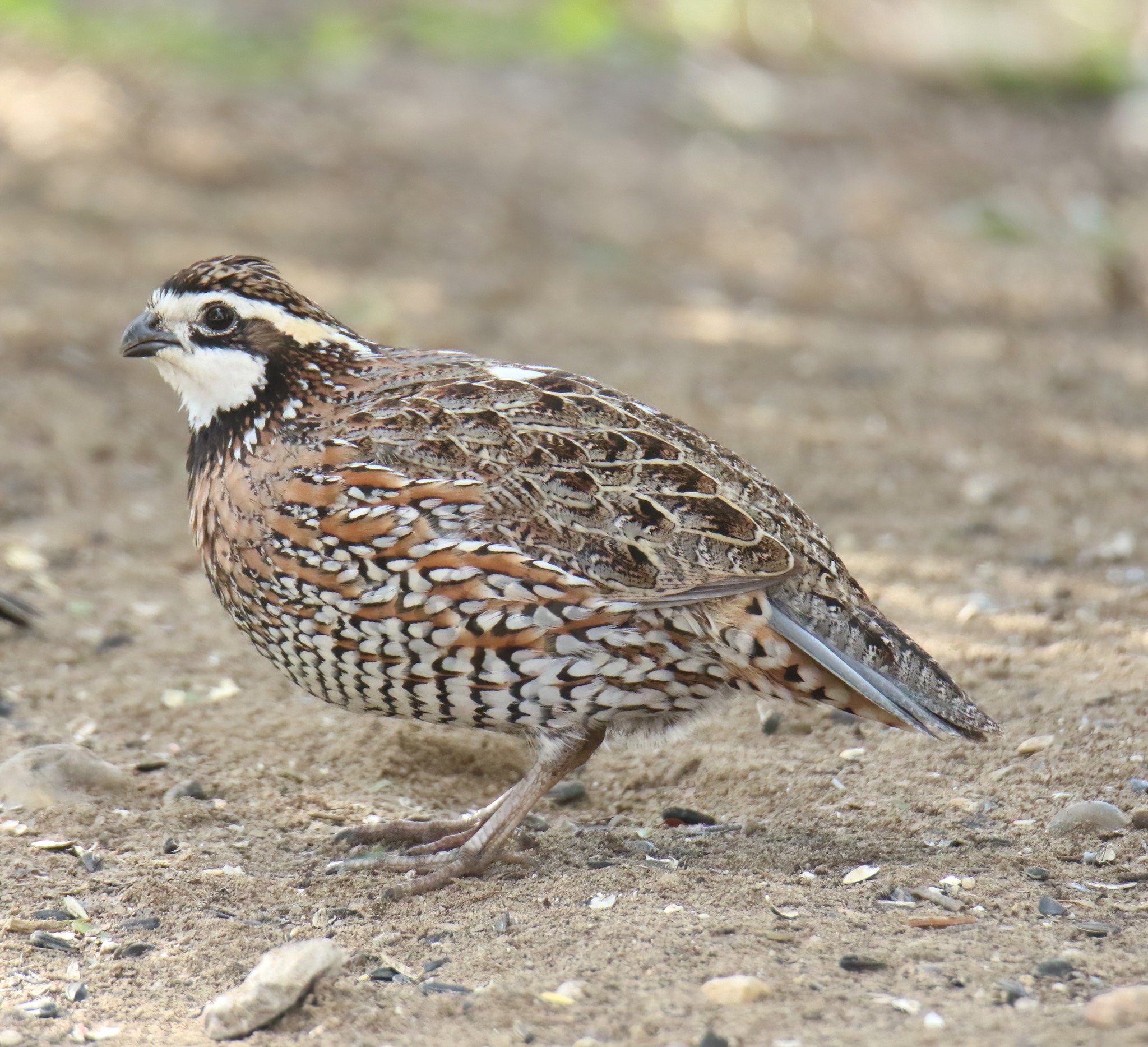
The Northern Bobwhite is a short and stout bird. They have small heads and short tails, adding to their overall rounded appearance. They have patterns of browns, blacks, reds, and whites covering their bodies and a distinctive white or buffy eye-stripe and throat. Sometimes, they have a crest of feathers on the tops of their heads, which they can raise and lower.
Northern Bobwhites can be found in croplands, fields, and forests, though they seem to prefer a patchwork of all three. They mainly consume seeds and leaves, but will add insects into their diets during breeding season. To feed, they will gather in groups and walk along the ground, pecking when they find seeds.
These groups, called coveys, stay together throughout the night as well, sleeping on the ground in a circle formation with their tails towards the center. This strategy might be useful for staying warm or for keeping an eye out for predators. The group works together to survive, though tensions rise during mating season when the males begin to compete with one another.
To build their nest, a pair Northern Bobwhite will make a scrape (shallow indentation) on the ground. Then they will line it with grasses and other vegetation. Sometimes, they will even weave together strands of grass to form an arch over the nest. This hides the nest from any predators that might be passing nearby or overhead. Remarkably, Northern Bobwhites can lay up to 28 eggs in a single clutch, and can lay up to three clutches per breeding season.
Northern Bobwhites are well beloved by Texans, but their populations have still taken a steep dive in the past fifty years. According to the North American Breeding Birds Survey, the Northern Bobwhite population decreased by about 80% between the years 1966 and 2019. This is a very concerning drop, though there are still enough bobwhites in the wild that they aren’t listed as an endangered species. Much of the decrease can be attributed to habitat loss through urbanization and fire suppression as well as pesticides and herbicides.
Northern Bobwhites are just one of many grassland species that are declining from habitat loss. According to the National Bobwhite & Grassland Initiative, 99% of native grassland habitats hundreds of millions of acres across the eastern US have been eliminated or degraded. Because of this, grassland birds and other wildlife rapidly declining. The Northern Bobwhite has become a figurehead of this loss and mascot for its rescue.
Fortunately, there are many people and initiatives who are working to solve the problem of our vanishing grasslands and bobwhites. Many individuals, private organizations, and even government entities have been involved in conserving this bird and its habitat. Let’s hope for a brighter future for the Northern Bobwhite and a thriving grassland habitat in the future!
Photo credit: Sheryl Travis
Photo caption: A Northern Bobwhite

