
By Ruth Ann Ruiz
The Post Newspaper Features Editor
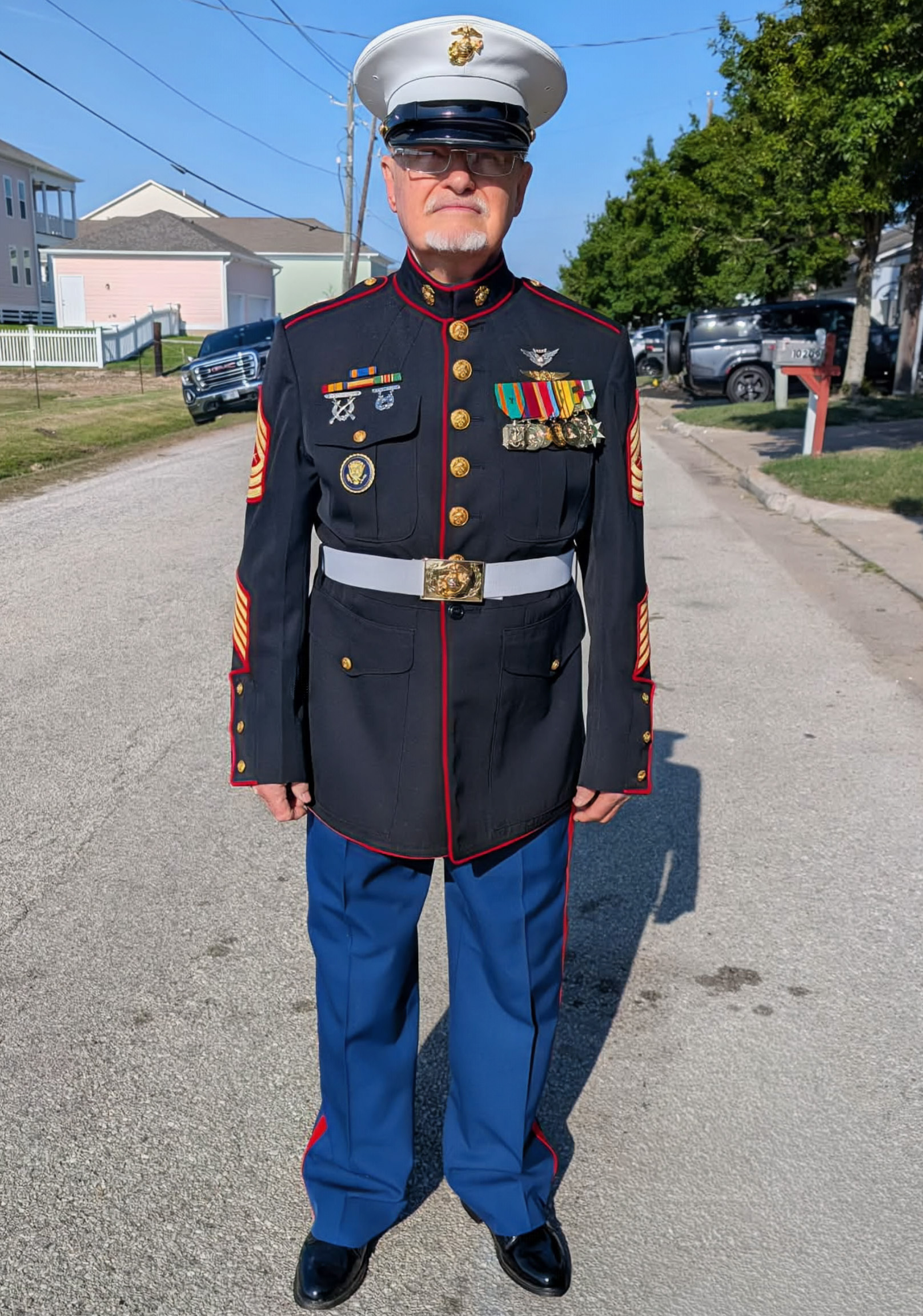
It’s been many decades since retired Master Sergeant Charles Wiggins wore his U.S. Marines dress blue uniform as an active-duty Marine. Wiggins truly embodies the slogan, “Once a Marine, always a Marine.” He is in his mid-80s and yet he continues to maintain the physical form that was required of him as an active-duty Marine.
As he spoke to an audience at Lighthouse Charities Team, his voice conveyed not only his Georgia accent, but also conveyed a gentle soul, a peacemaker. Listening to him speak, it was hard to imagine he is a trained warrior who served combat tours as a U.S. Marine.
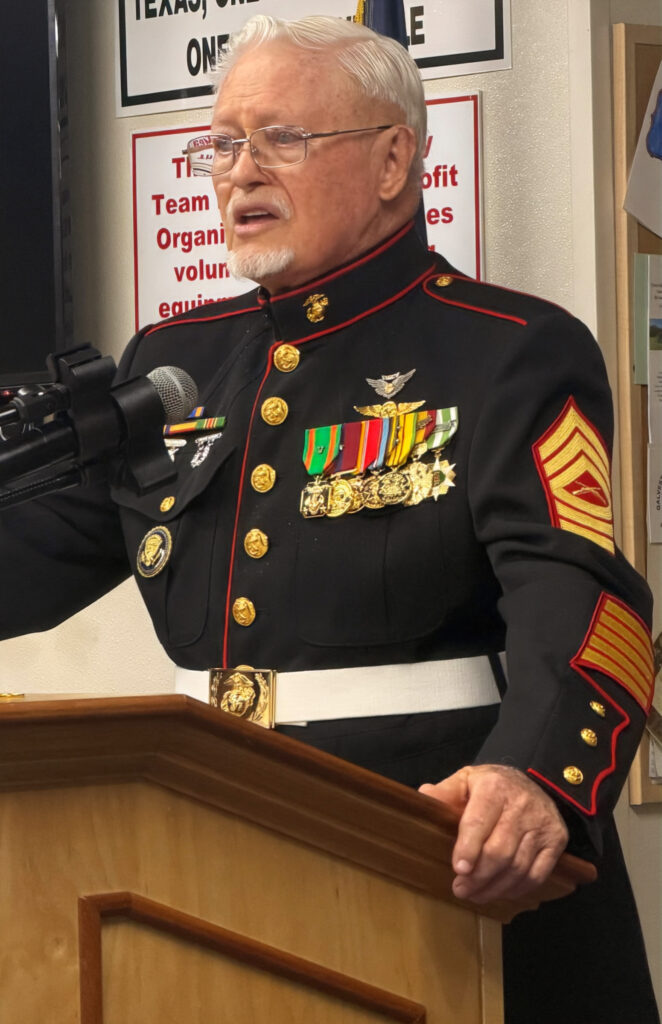
Through his gentle but firm voice, he captured his listeners with his military career along with a journey back to WWII.
“During the battle of Iwo Jima 7,000 Marines lost their lives, another 20,000 military personnel were wounded. Eighteen thousand Japanese soldiers were killed and 1,083 were captured. That is why when I am wearing my Dress Blues I carry with me ashes from Iwo Jima,” said Wiggins, as he showed the audience his small vial of ashes.
Wiggins explained as a young man he had watched the movie, the Sands of Iwo Jima and he just knew it was his destiny to serve our nation as a United States Marine.
“I told my parents I was going to quit school and needed their permission to join the Marines,” said Wiggins.
His parents objected, but he persuaded them by reminding them he would soon turn 18 and would not need their signature to enlist. They gave their permission and soon he was in boot camp at Parris Island in South Carolina. Next, he attended infantry training at Camp Lejeune.
After infantry training, he was sent to Florida for aviation fundamentals and then onto ordnance training. Then came his tours of duty.
He was a member of the helicopter support crew for the Bay of Pigs, but Wiggins reminded the audience, the U.S. military was ready but did not engage in conflict.
Then he went on to some less conflict-oriented assignments such as serving on one of the first US ships to traverse the waters of the English Channel since WWII. After serving in Europe, he was sent to Vietnam and was assigned to a Huey gunship squadron.
“I was a qualified gunner and during the Tet Offensive of 1968, I was shot down over North Vietnam and then rescued by a helicopter,” said Wiggins. “In June 1968 I received a battlefield promotion to Gunnery Sergeant.”
His time in conflict zones was over in September 1968 when he was ordered to report to Quantico, Virginia to serve on the Presidential Support Helicopter Squadron. There he was the NCO in charge of the hydraulic shop and was trained and then qualified as a crew chief for every helicopter in the Marine inventory.
New orders took him away from his work on the Presidential Squadron and sent him to Japan.
While in Okinawa, Japan, Wiggins was recognized for developing a means of balancing the nose wheels of the KC-130 aircraft to eliminate excessive vibrations on takeoffs and landings. Next came his promotion to Master Sergeant and he was ordered to New River, North Carolina.
But he didn’t end up in New River, a former commanding officer recognized him and let him know his training and skills were needed on the Presidential Helicopter team. So once again Wiggins was in Quantico.
His life got a bit complicated. While in Quantico, he was detained by military police because he was supposed to be in New River. There was a mix-up in paperwork that needed to be worked out. Once all papers were cleared, he again had the honor of serving on the Presidential Helicopter squadron where he served until his military retirement in 1976.
In his career he served with the Presidential Helicopter crew during the Nixon, Ford, and Carter presidencies.
Wiggins explained that during one of his duty stations in the United States, he recognized being an ordnance specialist had no place in the civilian world, which is why he had signed up for training beyond being a gunner. He became a helicopter expert, and he did complete his G.E.D. during his first year as a Marine.
After retirement, he went to work for Bell Helicopter in Amarillo, Texas, where he rose up through the ranks to supervising the refurbishing of 30 helicopters per month back into service for the U.S. Army. He further went on to complete a degree in criminal justice, which he explained wasn’t of much value as he stayed the course in being a helicopter inspection supervisor.
He brought his presentation to an end by reading the following poem to the audience.
Ask Me What I Was
I’ll reply with what I’ve done
Those things others would not do. I did
Those rivers others would not swim. I swam
Those hills others would not cross. I crossed
I have celebrated. I have mourned
I have smiled and I have frowned
I have seen death and felt its warm breath.
It did not faze me. For I was different.
I was a warrior
You ask me what I was?
It was my destiny. Until my last breath
To be a United States Marine
And my spirit shall forever
Semper Fidelis
For I was, am and shall forever be a
United States Marine.
Thank you, Master Sergeant Charles Wiggins, for your dedication to being one of the best of the best!
Our military pilots’ lives and the success of their missions are dependent on the dedication, steadfastness and loyalty of the hands and hearts of those who assure that all is well with their aircraft.

