
By Martin Hagne
During late March through early May, birders flock to the Texas coast in hopes of seeing the many neotropical migrant birds heading back north to their summer breeding grounds. Some of these birds nest here or very near us, while others travel on a far as northern Canada. It’s a long, hard, and dangerous trip, with many hazards, many of which were created by us humans.
But there are, of course, natural threats to small songbirds, some only weighing a nickel’s-worth! It’s rather amazing that such a small and very lightweight bird can make such an arduous trip, leaving the Yucatan in Mexico, crossing the huge Gulf of Mexico, and heading straight for the upper Texas and Louisiana coast. The long flight might take 18 hours or more over a very hostile open ocean.
If a strong thunderstorm with pelting rain and hard winds–especially northern winds—is encountered in the Gulf, it could mean doom for such a small bird. A late “Norther,” pushing south across the coast or nearshore can also be disastrous. As sad as it sounds, once a songbird hits the water, there is no recovery. And as everything in nature is truly tied together, there are even species of shark that has the same migration timing as birds, feasting upon downed birds in the open waters. Similarly, a recent university study found that Tiger shark mothers bring their young nearshore to let them feed better and that includes many downed songbirds.
This spring, migration started very much the same. A few early birds in March, along with a few birders out looking. There is normally a small push of migrants in late March, then a slower lull until mid-April. But mid-April came, and we weren’t seeing many birds. Even in the main migration push that spans the last two weeks of April into the first week of May, only small numbers of birds showed up, in what some birders would call a “slow migration.”
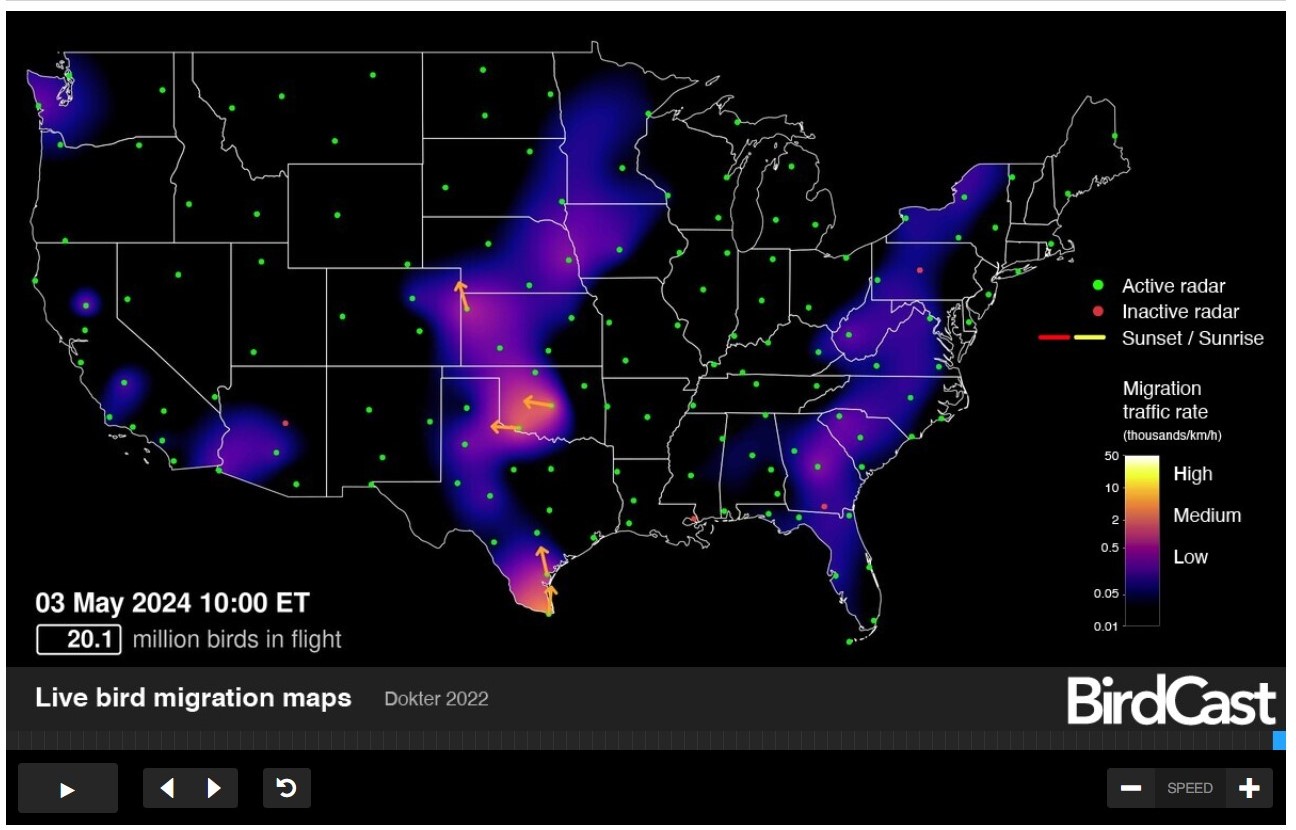
But was it really a slow migration? It is true that since the 1970’s we have lost 30% mass of birds overall, a huge loss that continues. Therefore, we won’t see as we once would. But that doesn’t mean birds aren’t migrating. In fact, each night, millions, and on some nights hundreds of millions of migrants fly right over us! BirdCast, which uses radar to track live bird migration, is showing 20.1 million birds in the air moving north in North America as I write this article here in the Gulf Coast Bird Observatory!
So, what gives? Why are so few migrants being seen along the so very important coastal habitats this year? It’s a very simple fact: strong southerly winds for almost two months straight. Birds can somehow “sense” wind directions and can actually find the layers of most advantageous wind patterns in the atmosphere.
Once in flight, they can rise or ascend into layers of wind speed and direction that are best for them. A southerly wind carries them along, a tail wind so to speak, pushing them North. This is a huge advantage to a migrating bird, helping it save energy stores that were built up over time before migration. It can fly faster and longer and is mostly able to bypass the coastal stopover sites they would use most years.
How far they push inland depends on their remaining energy stores and weather patterns inland. That’s a great thing for a bird, but not for watching them. I’m rooting for the birds, so let them fly! We will see them sometime! And now that migration is waning, birds are reaching or already have reached their breeding destinations, singing to hold territories, and attracting mates, just like it should be!
Image: Dokter, A. 2024. BirdCast, live migration map; 5/3/2024 10:00 ET Cornell Lab of Ornithology. https://birdcast.info/migration-tools/migration-forecast-maps. 5/3/2024.
Caption: A BirdCast migration map forecasting the millions of birds migrating over North America.

