By Hannah Beckett
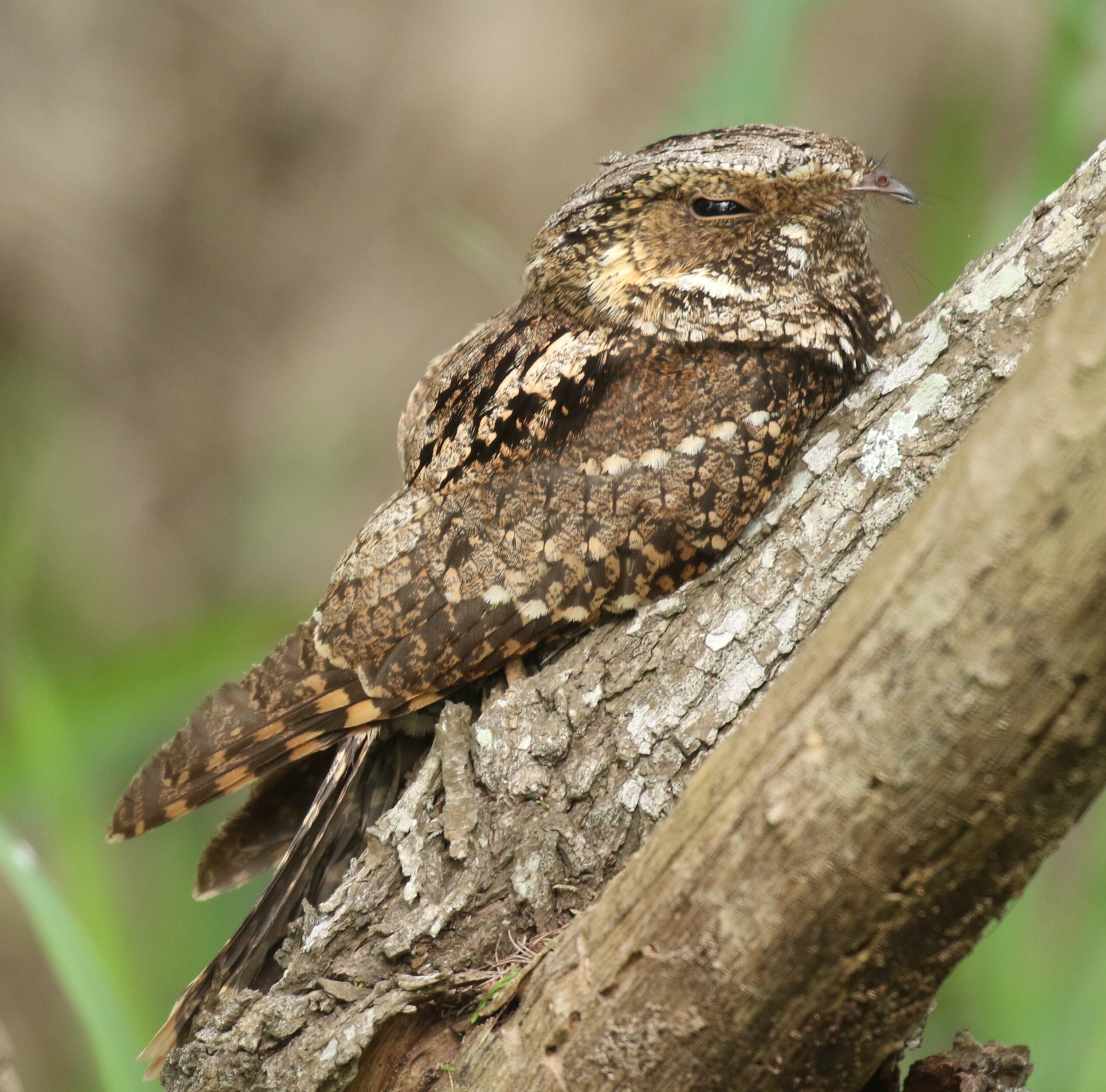
If you go outside on a warm summer night, you might hear the throaty chant of the Chuck-will’s-widow (Antrostomus carolinensis). This nocturnal bird with its cryptically colored feathers is rarely seen in the daylight despite being the largest nightjar species in North America. The Chuck-will’s-widow is an understudied species in comparison to other nightjars. Much of the information about Chuck-will’s-widows are assumptions based on the biology of the more widely studied Common Poorwills and Eastern Whip-poor-wills.
Chuck-will’s-widows are migratory birds who winter in the neotropical regions of Central America, northern South America, and the Caribbean. Some even winter on the southern tip of Florida. In the spring, Chuck-will’s-widows migrate to nesting sites across the Southeastern US, including Texas.
Chuck-will’s-widows typically choose nesting sites in open, mixed pine and hardwood forests. Breeding begins in April and lasts until June. Chuck-will’s-widows typically choose nest sites near woodland edges with dense ground cover. Nests consist of a simple scrape in the ground with eggs laid on bare dirt or leaf litter. Their camouflaged plumage allows incubating adults to stay undetected until you almost step on them.
Chuck-will’s-widows are largely solitary except during breeding and migration. Most of the information we have on their behavior is based on detection of vocalizations. Singing occurs most often at dusk and on nights with bright moonlight. Male Chuck-will’s-widows can call up to 16 to 30 times per minute! During courtship, males will sing and growl to attract females and defend territories but will stop while nesting. Chuck-will’s-widows don’t call during migration which makes their migratory behavior difficult to observe and track.
The Chuck-will’s-widow along with many other nightjar species belong to the family, Caprimulgidae, which literally means “milker of goats”. The name is based on an ancient belief that the birds milked goats with their enormous mouths each night. However, these crepuscular and nocturnal insectivores use their large, wide mouths to scoop up flying insects such as beetles and moths. They may occasionally swallow small birds and bats as well!
Chuck-will’s-widows forage at dawn and dusk and on moonlit nights. If streetlights are present, they may use the light to forage most of the night. Special feathers around the mouth, called rictal bristles, help funnel insects into their wide mouths. They are agile in flight, giving chase after its prey with their long, narrow wings.
While the Chuck-will’s-widow is considered a species of low conservation concern at this time, their population has shown a steady rate of decline for the past 50 years. Since their numbers are still too great to warrant a Watch-List status, Chuck-will’s-widows have been included on the Common Birds in Steep Decline list. Pesticides and habitat loss are considered likely reasons for their decline in numbers.
It is difficult to complete accurate surveys of the population due to their nocturnal habits, but many organizations and individuals are making efforts to study this species and ensure conservation efforts are made to protect the Chuck-will’s-widow.
So next time you’re outside on a summer night, keep an ear out for the distinct chant of the Chuck-will’s-widow.
Photo: South Padre, Chuck-Will’s-Widow, Antrostomus carolinensis
Credit: TonyCastro/SeeWorthyBirds, Public domain, via Wikimedia Commons

